Amazon Listing Optimization: Fix What Kills Conversion Before You Scale Traffic

The fastest way to earn organic rank, lift conversion, and make ads work harder at scale.

  • Adverio - increase Conversion-first, proprietary Revenue Impact Formula-led
  • Adverio - increase Built to hold up as your catalog grows
  • Adverio - increase Foundation of Adverio's growth system

15-minute call. Bring one ASIN and its last 90 days.

Built for brands with 10 to 1,000s of SKUs • Powered by AMOS, the Adverio Marketplace Operating System

The score

What is a listing quality score?

A listing quality score rates how ready a product detail page is to convert a human shopper. Adverio scores it as LQS, out of 10, across five inputs. It is not a grade on the copy. It is a read on which of the five is holding the page back, so the fix order gets decided by the weakest input rather than by preference.

  • Offer structure and variant logic
  • Media clarity and first-screen impact
  • Copy alignment with buyer intent
  • Review strength and objection coverage
  • Compliance and category requirements

A page can score well on four inputs and still lose the sale on the fifth, which is why the score is reported by input rather than as a single number on its own.

LQS covers the human decision only. Whether an AI shopping agent can read the same page and add it to a cart is scored separately as AACR, because the two fail for different reasons and get fixed in different places.

Amazon listing optimization is the work of improving every element that drives conversion on a product detail page, from the title and bullets through images, A+ content, backend search terms, pricing, reviews and parentage. It is not a one-time cleanup. A listing that fails to convert trains the algorithm to stop showing it.

CONVERSION BEFORE SPEND

The Traffic Is There. The Spend Is Real. The Listings Are the Leak.

Every unconverted session is ad spend you already paid for, and it compounds. Bad listings don't just lose sales. They inflate your TACoS, suppress your organic rank, and make every future ad dollar work harder than it should.

We'll show you which SKUs are bleeding spend and what to change first, in priority order, not guesswork.

Bearded Brothers logo Vahdam logo SANS logo Mixology logo Adverio Amazon client brand logo Adverio Amazon client brand logo Adverio Amazon client brand logo Adverio Amazon client brand logo Adverio Amazon client brand logo Adverio Amazon client brand logo Adverio Amazon client brand logo Adverio Amazon client brand logo Adverio Amazon client brand logo Wildflower logo Macnaught logo MK Supplements logo JS Health logo Hello Health logo Karat Tea Zone logo Tekk-Protek logo Crazy Dog T-Shirts logo Karat logo Levtex Baby logo QPS logo Adverio Amazon client brand logo Shoe Bond logo FyterTech logo

Why Listings Come Before Ads (And Why the Order Gets Reversed)

Brands often try to buy their way out of a poor shopping experience and low conversion rates with ads. That's the mistake.

If a PDP isn't extractable, compliant, and conversion-efficient, Amazon PPC simply accelerates inefficiency that wastes your hard-earned cash.

On Amazon, eligibility and AI shopping agents (Alexa for Shopping, formerly Rufus, and COSMO) determine visibility. Conversion determines whether that visibility and organic ranking stick.

Fix eligibility. Strengthen conversion. Then add fuel.

More than 60% of Amazon's total sales come from third-party sellers, with over 2 million active sellers on the platform globally, according to Amazon's 2024 SMB Impact Report. At that volume, a weak listing doesn't just underperform, it gets buried.

What This Means

  • Eligibility + extractability determine agent visibility
  • Higher CVR improves organic rank and ad efficiency
  • Lower TACoS comes from stronger PDPs, not lower bids
  • Conversion efficiency defines how far and how fast you can scale
Read Case Studies

Conversion + Eligibility Systems (Not "Amazon SEO")

Amazon SEO usually stops at rewriting bullets. That approach breaks at scale.

Adverio was built for operators managing complex catalogs, where conversion, eligibility, and profit matter more than cosmetic rewrites.

We optimize for three layers simultaneously:

  • Buyer Intent Alignment (Human Conversion Layer)
  • Machine Interpretability (Agent Visibility Layer)
  • Compliance Gates (Eligibility Layer)

Keywords get you indexed. Eligibility, interpretability and conversion efficiency decide whether that indexing turns into revenue.

Data-First Decisions

Every optimization is driven by buyer-intent data, CTR benchmarks, and performance deltas against category leaders, not opinions.

Large-Catalog Intelligence

Repeatable systems hold quality across catalogs of any size, from a focused range to tens of thousands of SKUs, without linear cost or quality decay.

Profit Accountability

We track indexation growth, conversion lift, rank velocity, and revenue impact, not deliverables.

Amazon FBA fulfillment fees increased an average of 5.2% in 2024, with fees now representing 15-35% of selling price depending on product size and category, per Jungle Scout's 2024 FBA fee analysis. Listing optimization that ignores margin math isn't optimization, it's cosmetic work.

PDP Check

You've Seen the Problem. Let's Diagnose Your Listings

You already know weak PDPs waste ad spend. Let's break down where your listings are losing conversion and visibility.

Start My Listing Diagnostic

👋 You've visited this page before. Let's find what's holding your growth back.

Every Engagement Starts With a Listing Diagnostic

Before ads scale, we diagnose what's limiting performance. Every SKU is scored through Adverio's proprietary systems to surface conversion leaks, indexing gaps, and compliance risks, fast.

Two scores, and more add-to-carts is what both are for.

Amazon is no longer just search-driven, it's agent-influenced. Optimizing for humans is necessary, but no longer sufficient.

Every listing is evaluated across two distinct readiness scores:

LQS Human PDP Conversion Readiness
AACR Agent Add-to-Cart Readiness

A listing can pass one and fail the other, which is why they are scored apart rather than averaged.

Both scores are tracked over time alongside the rest of your account data in Adverio's marketplace business intelligence reporting.

LQS (Listing Quality Score)

Human PDP Conversion Layer

  • Offer structure & variant logic
  • Media clarity & first-screen impact
  • Copy alignment with buyer intent
  • Review strength & objection coverage
  • Compliance & category requirements

AACR (Agent Add-to-Cart Readiness)

Machine-First Optimization Layer

  • COSMO intent coverage depth
  • Alexa for Shopping question resolution mapping
  • Semantic clarity for Amazon systems
  • Offer reliability signals
  • Review risk exposure analysis
  • Terms of Service alignment (hard gate)

CTR & Indexation Benchmarking

Category-Level Performance Context

  • Historical performance baseline
  • Category median comparison
  • Top five competitor benchmarks
  • Keyword-level indexing gaps

The average Amazon seller operates on a net margin of 10-20% after accounting for COGS, FBA fees, advertising costs, and referral fees, according to Helium 10's 2025 State of the Seller Report. A 1-point improvement in conversion rate can meaningfully shift that margin band.

Benchmark logic

Why CTR Benchmarking Matters

CTR tells us whether your listing earns the click, not just ranks. We compare your historical CTR against category medians and the top five listings to quantify lift and uncover opportunity.

We use CTR benchmarking to validate lift and opportunity.

View CTR Calculator

Ads amplify visibility. CTR determines whether that visibility converts.

Proven at Scale Across Brands

Adverio - Levtex Home Baby 1

+1,119% Profit Surge in 51 Months

Product Category: Softlines > Home & Kitchen > Bedding

Adverio - CDT Amazon

+32% Profit Gains in 4 Months

Product Category: Softlines > Apparel > Novelty Tees

Explore Case Study Adverio Logo
Adverio - BeyBerk 1

+407% Profit Gains in 25 Months

Product Category: Home & Kitchen


Explore Case StudyAdverio Logo

What We Diagnose Before Revenue Flatlines

Optimization without diagnosis doesn't just waste time, it increases risk.
Before we change copy, media, or ads, we identify what's already breaking (or about to).

Before we touch anything, we surface:

  • What is suppressing visibility, extractability, or conversion
  • What will break under scale or eligibility review
  • What is still hidden because spend is covering it

Brands usually don't discover these issues until:

  • TACoS drifts
  • Spend climbs and the revenue behind it does not
  • Or topline stalls despite "best sellers"
  • By then, they're already late.

Compliance Gaps (Alexa for Shopping / COSMO / ToS)

Compliance issues don't fail loudly. They fail slowly, through distribution limits, trust erosion, and sudden enforcement.

Compliance work is not about avoiding a penalty. It protects the scale you are about to add, so growth does not trigger a setback.

Outcome
Stable visibility as volume increases Fewer surprise disruptions during scale

Keyword Intent & Query Mapping

When intent is misaligned, traffic looks healthy, but conversion stalls.

Ads fill the gap temporarily. Margins absorb the cost quietly.

Correct intent mapping restores demand efficiency so clicks convert without needing constant bid pressure.

Outcome
Higher CVR without higher spend Ads stop compensating for relevance gaps

Indexation, Suppression & Category Errors

If Amazon doesn't trust your listing, it limits distribution. If distribution is limited, revenue caps, regardless of ad spend.

Indexation is the cap on how much organic demand you can capture. Lift the cap and ads stop carrying the load.

Outcome
More revenue per impression Less dependency on paid traffic

What We Build to Lift Conversion

Every system we build is designed to optimize Amazon listing performance at scale, so improvements compound across catalogs, not just single SKUs.

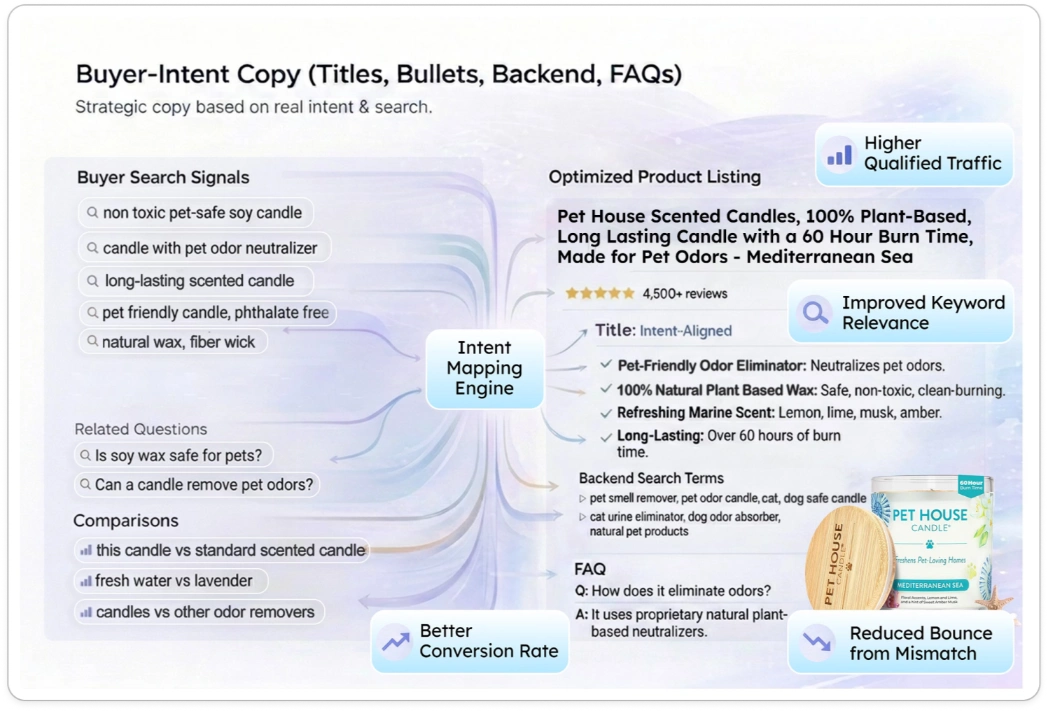
Buyer-intent copy system diagram showing search signals mapped to an optimized Amazon listing title, bullets, backend terms and FAQ

Buyer-Intent Copy (Titles, Bullets, Backend, FAQs)

We build buyer-intent copy systems that align how shoppers search, scan, and decide.
Every title, bullet, backend term, and FAQ is engineered to capture qualified traffic and convert it, without keyword stuffing or generic claims.

→ More qualified sessions, higher add-to-cart rate.

Conversion-Optimized Media (Images, 3D, Infographics)

We design visual systems that communicate value in seconds.
From first-image clarity to 3D renders and infographics, every asset is structured to reduce friction, answer objections, and speed up decisions.

→ Faster comprehension, fewer doubts, more buys.
See ten catalogs we have built
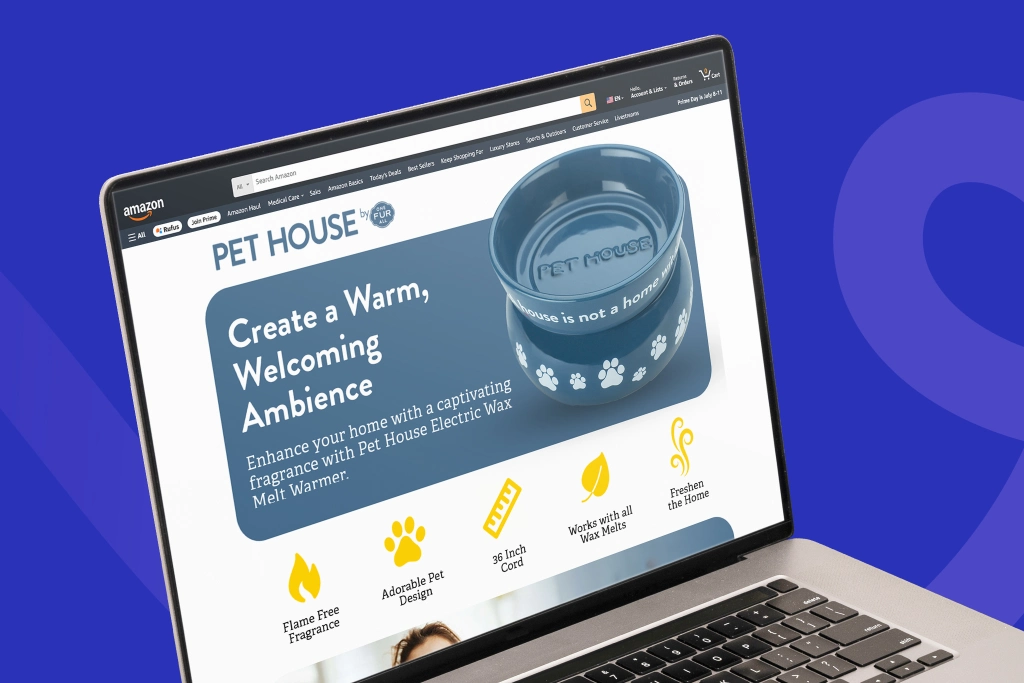
Amazon A+ content layout for Pet House showing a benefit-led hero module with feature icons on a product detail page

A+ / Premium A+ & Brand Story

We build A+ and Brand Story layouts as guided selling experiences, not decorative content.
Modular sections replace text-heavy PDPs with benefit stacks, proof tiles, and comparisons that reinforce trust and differentiation.

Structured Visual Modules

  • Benefit stacks mapped to top POE features

  • Objection-handling comparison blocks

  • Proof-driven trust tiles (materials, certifications, outcomes)

  • Visual hierarchy aligned to buyer decision sequence

→ Measurable CVR lift when structured visual modules replace unscannable text blocks.

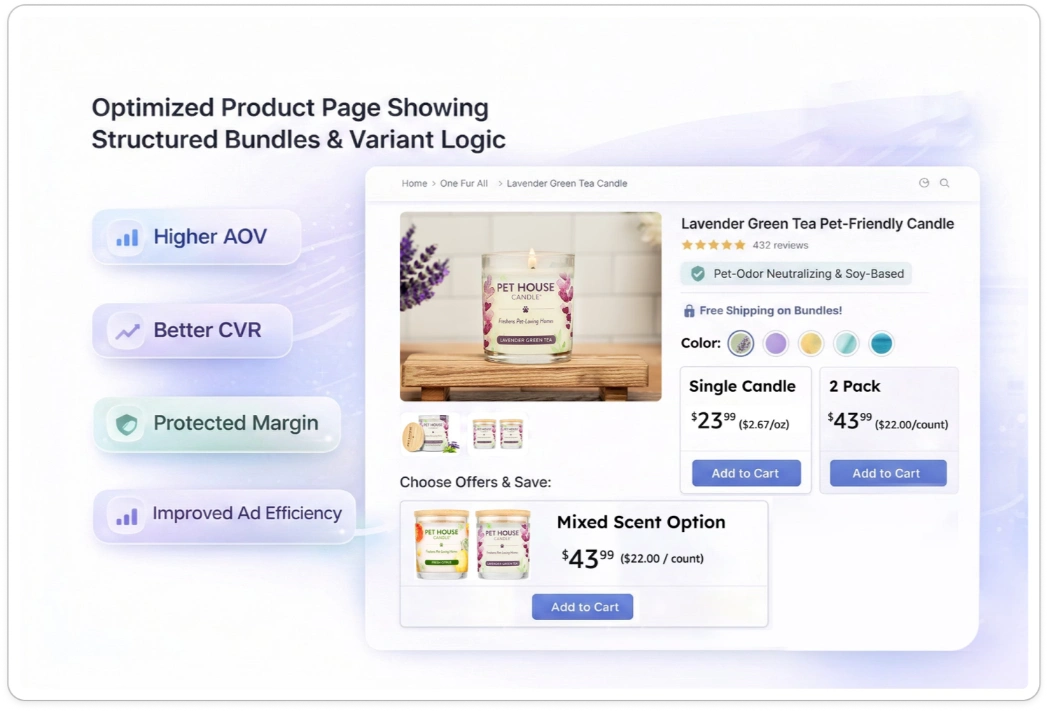
Offer & Variant Architecture

We engineer offer and variant systems that protect margin while improving conversion.
Parent-child structures, bundles, warranties, and promotions are designed to guide choice, not confuse it.

→ Clearer choice at the variation picker, and margin held on the bundle.
Adverio - image 40
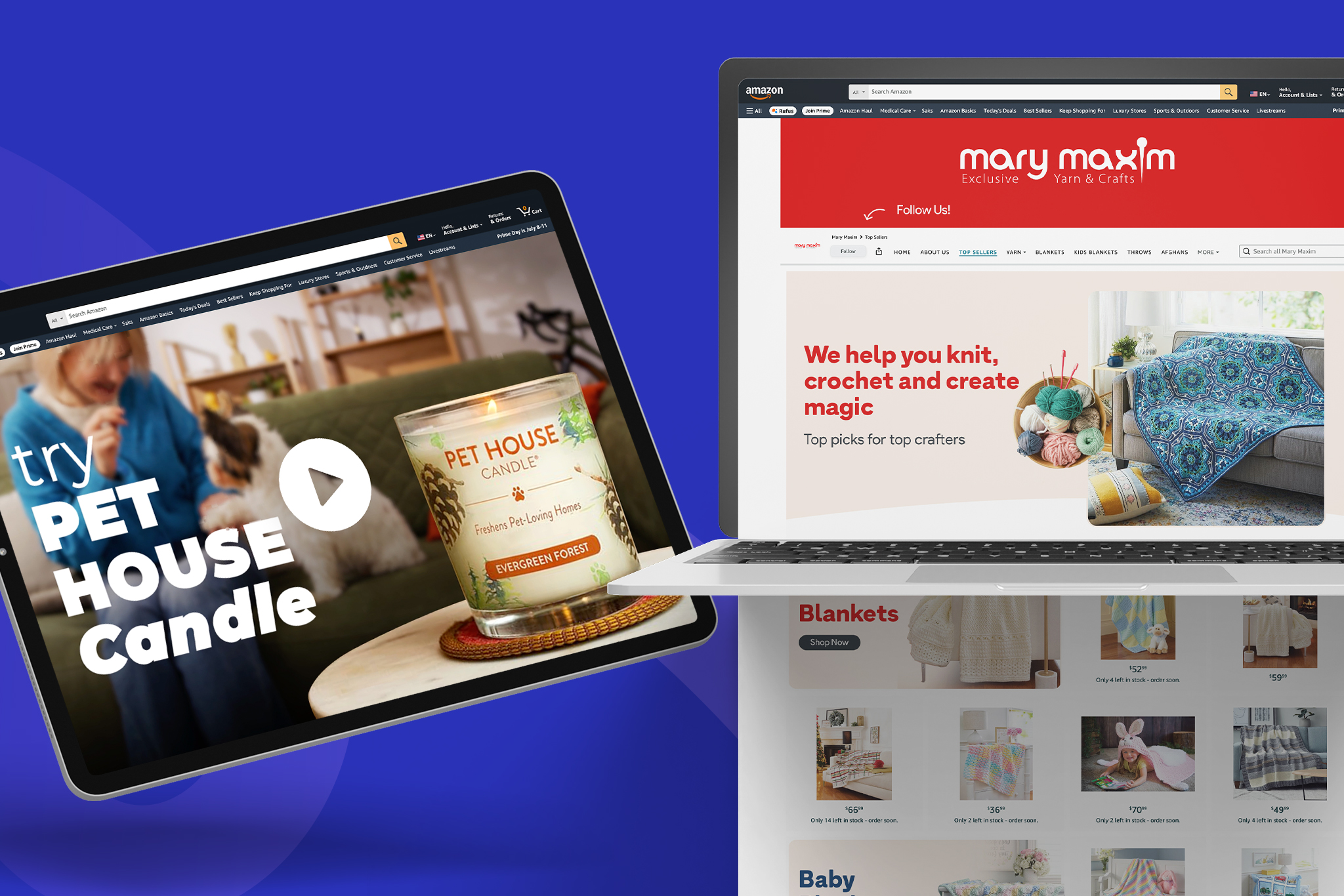
Amazon Brand Store layout with navigation pathways and embedded product video

Storefronts & Video (Built to Convert)

We build storefronts and video as conversion extensions, not brand décor.
Architecture is designed for dwell time, product pathways, and the Follow and Add to Cart cues that support PDP and ad traffic.

→ Higher CTR and CVR on video placements, and less purchase friction.

Creative direction

The images are the last step. The brief comes first.

Design work fails on Amazon when it starts with a design preference. Before anything gets drawn we write a brief that decides what each image in the set has to prove, in what order, and to whom. That brief is the deliverable a designer works from, whether we are rebuilding an existing set or building one for a product that has never been listed.

It gets built from your own account data, your reviews, your category, and the listings you are losing clicks to. Five blocks, every time.

The brief, five blocks

Who is buying, and who is not

Named buyer segments rather than one averaged customer, because a set that speaks to everyone converts nobody.

  • Two to four segments, named
  • What each one buys instead today
  • The one thing only you offer

What the reviews already tell us

Your reviews and your competitors' reviews are objection research nobody is paying for, and almost nobody uses them for creative.

  • What buyers hesitate over
  • What they praise unprompted
  • What they return the product for

What the buyer actually needs

The functional need is the easy half. The set only separates when it reaches the reason underneath it.

  • The functional job
  • The emotional payoff
  • The frustration the product ends

Product facts and category

Specs, materials, certifications, variant structure, and the category rules the set has to live inside.

  • Verified claims only
  • Category browse node and its norms
  • What compliance will and will not allow

The strategy

One segment to target, one position to hold, one hook. Everything the designer draws traces back to this block.

  • Target segment and position
  • The hook, in one sentence
  • The creative concept for the set

Then the image plan

Only now does the set get mapped. Each slot is assigned the objection it removes and the claim it proves.

  • Main image concept and variants to test
  • Gallery slot order by buying question
  • What moves into A+ instead

What are the Amazon product image requirements?

Amazon sets a floor. The main image needs a pure white background and at least 1,000 pixels on the longest side for zoom to activate. Clearing the floor is not the same as competing. A set that wins the click holds the product at 85% to 90% of the frame, ships at 2,000 by 2,000 pixels so the detail survives a zoom, and stays legible at thumbnail size, because the search grid is where the shopper sees it before anything else. Below is the check every set clears before it goes live.

The check every set clears before it goes live
WhereWhat we checkThe standard
Title It clears the character cap Under the 75-character limit Amazon began enforcing on 27 July 2026, with the buying decision made inside the first 60
Main image The product owns the frame Fills 85% to 90% of the image on a clean, distraction-free background
Main image Zoom holds up At least 2,000 by 2,000 pixels so the shopper can zoom without the detail falling apart
Main image It looks different in the grid A composition the category is not already saturated with, tested against the listings ranking above you
Gallery The set covers the whole decision Lifestyle, feature callouts, scale, packaging and a direct comparison, not six angles of the same shot
Gallery It reads on a phone Every callout legible at thumbnail size, because that is where the shopper sees it first
Gallery The people look like the buyer Models and settings that match the segment named in the brief, not a generic stock look
Whole set Every image earns its slot Each one removes a stated objection or proves a claim. If it does neither, it does not ship

Working this way means we can build a set for a product with no listing history and no existing creative, because the brief does not depend on there being something to fix. It depends on there being a buyer to understand.

Listing sets we built

Ten catalogs, ten categories,
one method behind all of them

Every set below was built from a written brief rather than a design preference. Each image had one job, which was to remove a stated buying objection or prove a claim the buyer would not take on faith. Tap any set to see it full size.

Pet supplies Sports and fitness Arts and crafts Grocery Apparel Medical apparel Hosiery Industrial supply Automotive parts Beverage

Pet supplies

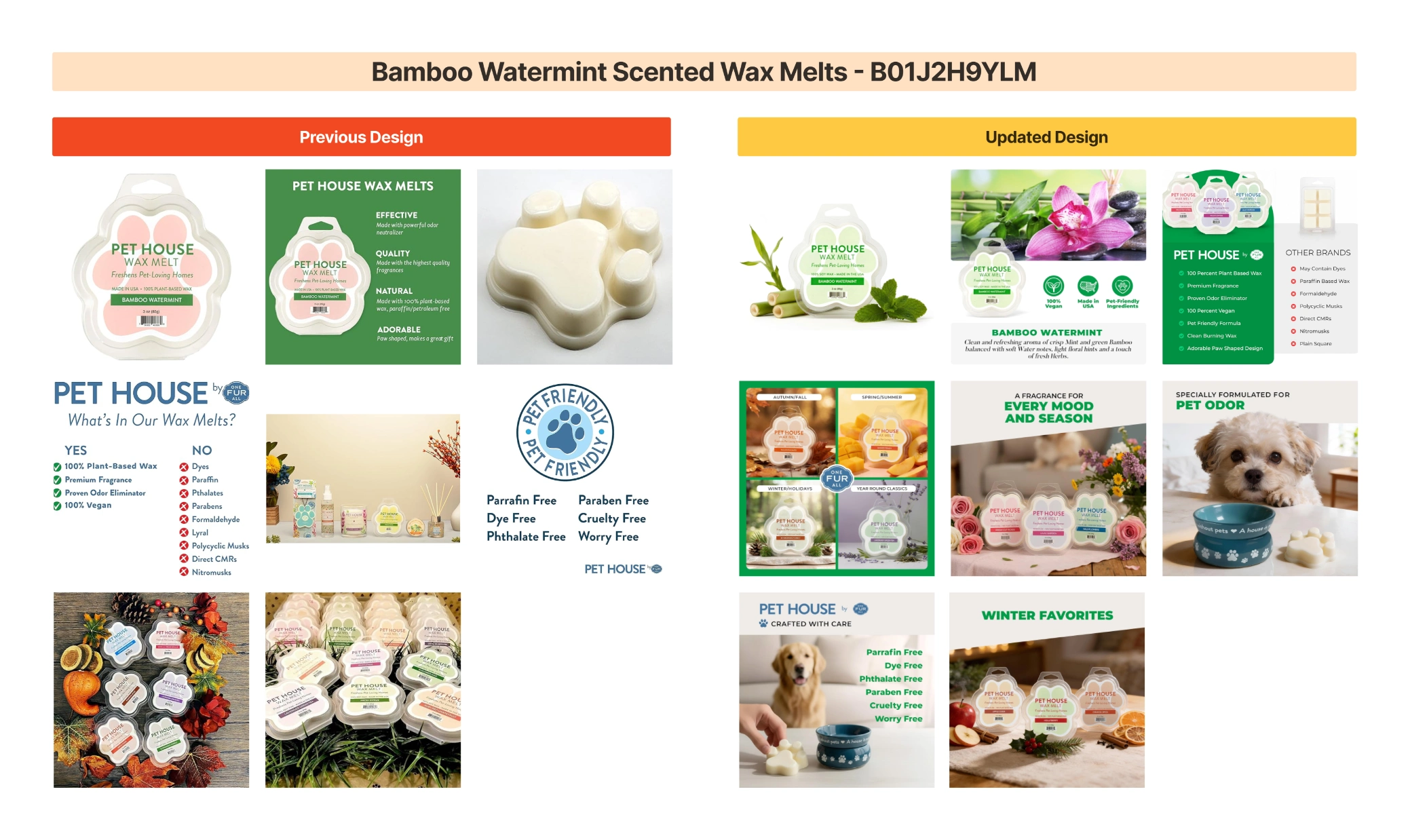
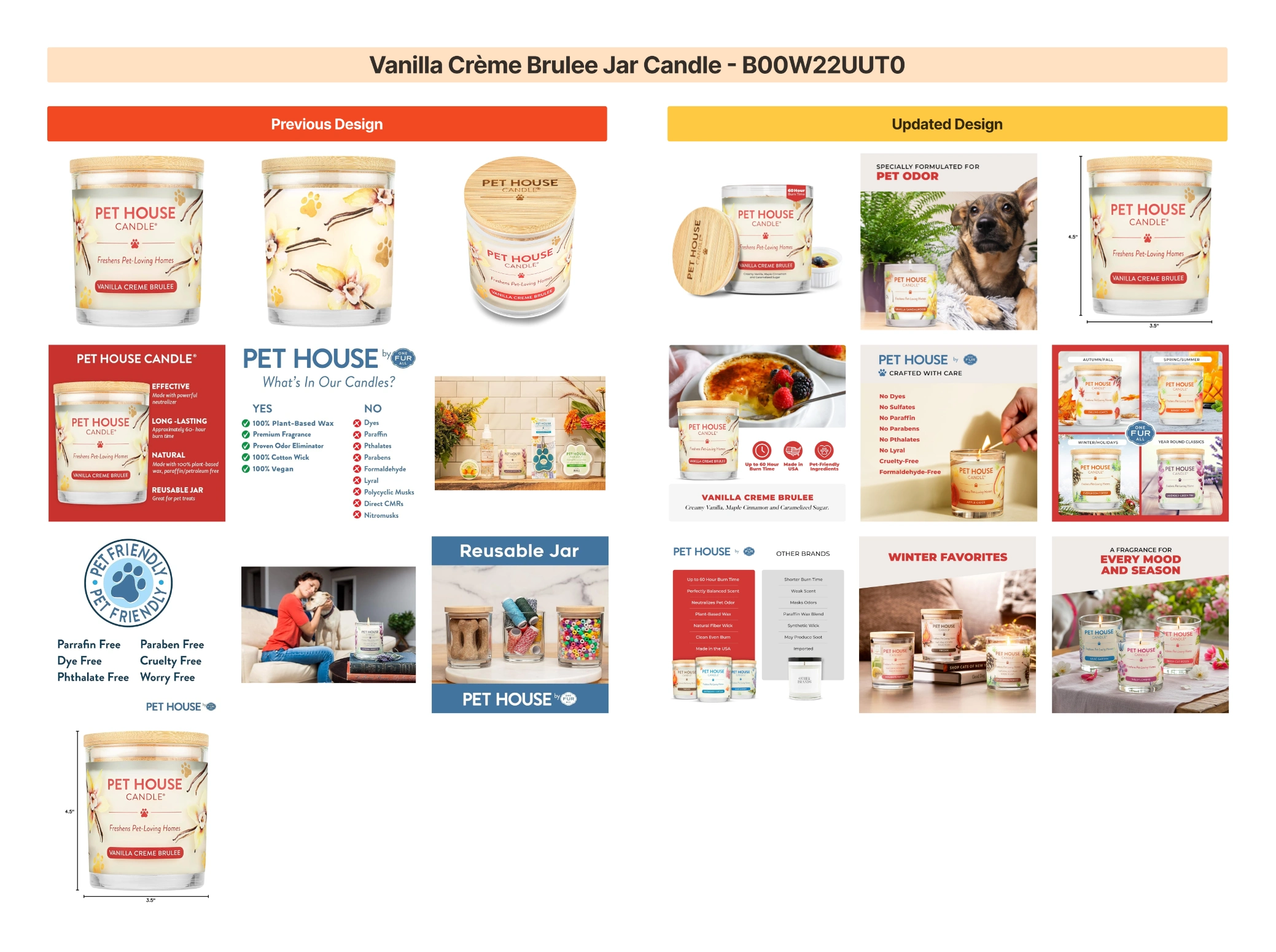
Pet House by One Fur All

A room spray sold into homes with animals carries two objections before price ever comes up, which are whether it is safe around pets and whether it masks odor instead of clearing it. The set answers both in the first two gallery slots, then shows the rooms the product is actually for.

Sports and fitness

Iron Neck

Load-bearing equipment sells on failure risk. The buyer wants to know it holds under tension and fits the gear they already own. Construction is shown at the stitch level, compatibility is named by product, and the full resistance range sits in one frame so nobody has to open the variation picker to find their weight.

Arts and crafts

Mary Maxim

Craft buyers abandon on spec ambiguity, because buying the wrong quantity ruins the project. The set puts fiber content, gauge and a yarn-per-project chart in the gallery rather than leaving them in a bullet nobody reads on mobile.

Read the Mary Maxim case study

Grocery

Bearded Bros

Clean-label claims are cheap to make and hard to believe, so the set proves them instead of asserting them. The ingredient panel and the certifications move into the gallery, and a side-by-side against generic bars gives the shopper a reason to pay more.

Apparel

Crazy Dog T-Shirts

A seasonal tee competes against listings that are cheaper and look identical in the search grid. The set separates on print quality, true-to-size fit and where the shirt is worn, then routes the shopper into the rest of the catalog rather than ending the visit.

Read the Crazy Dog case study

Medical apparel

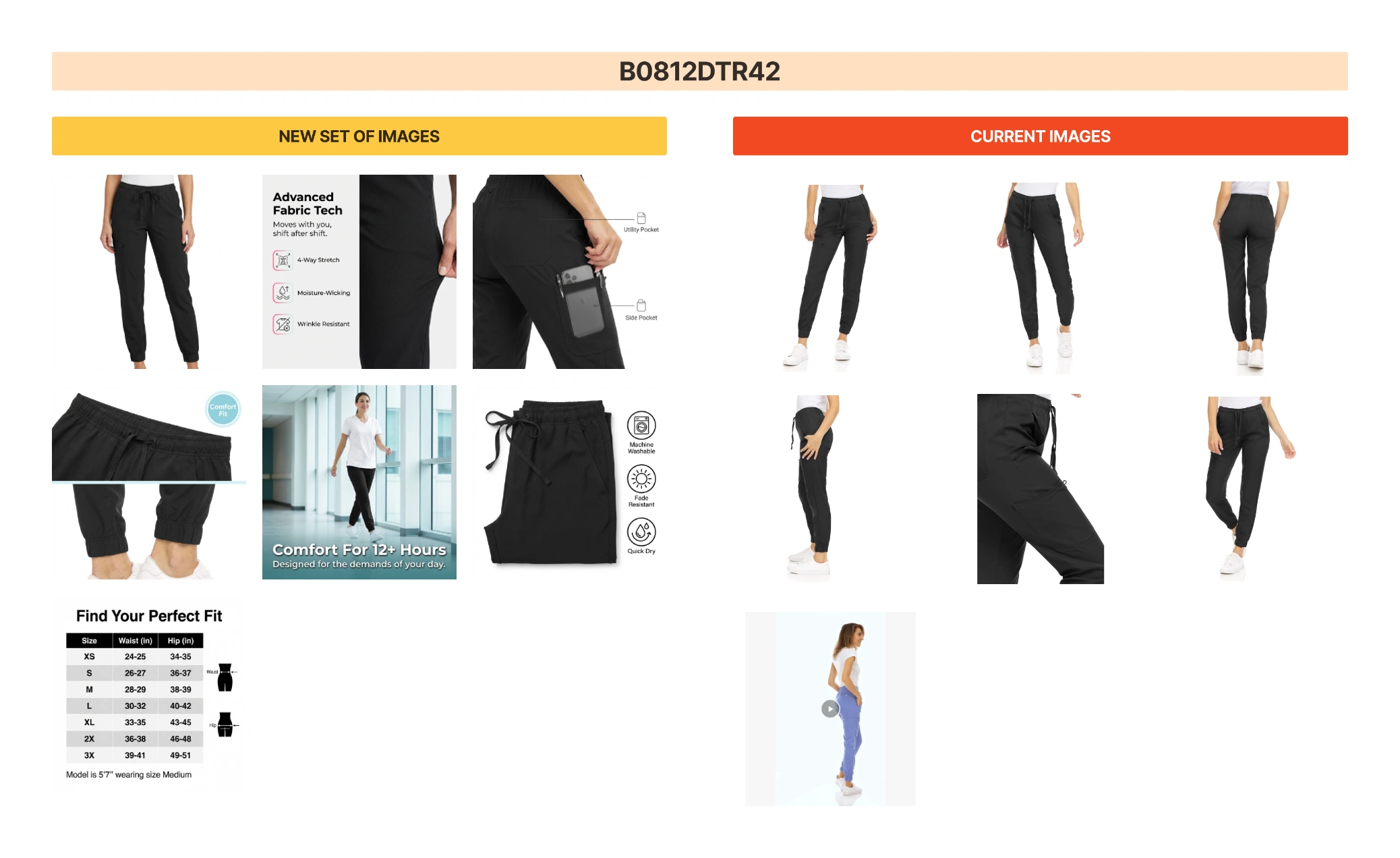
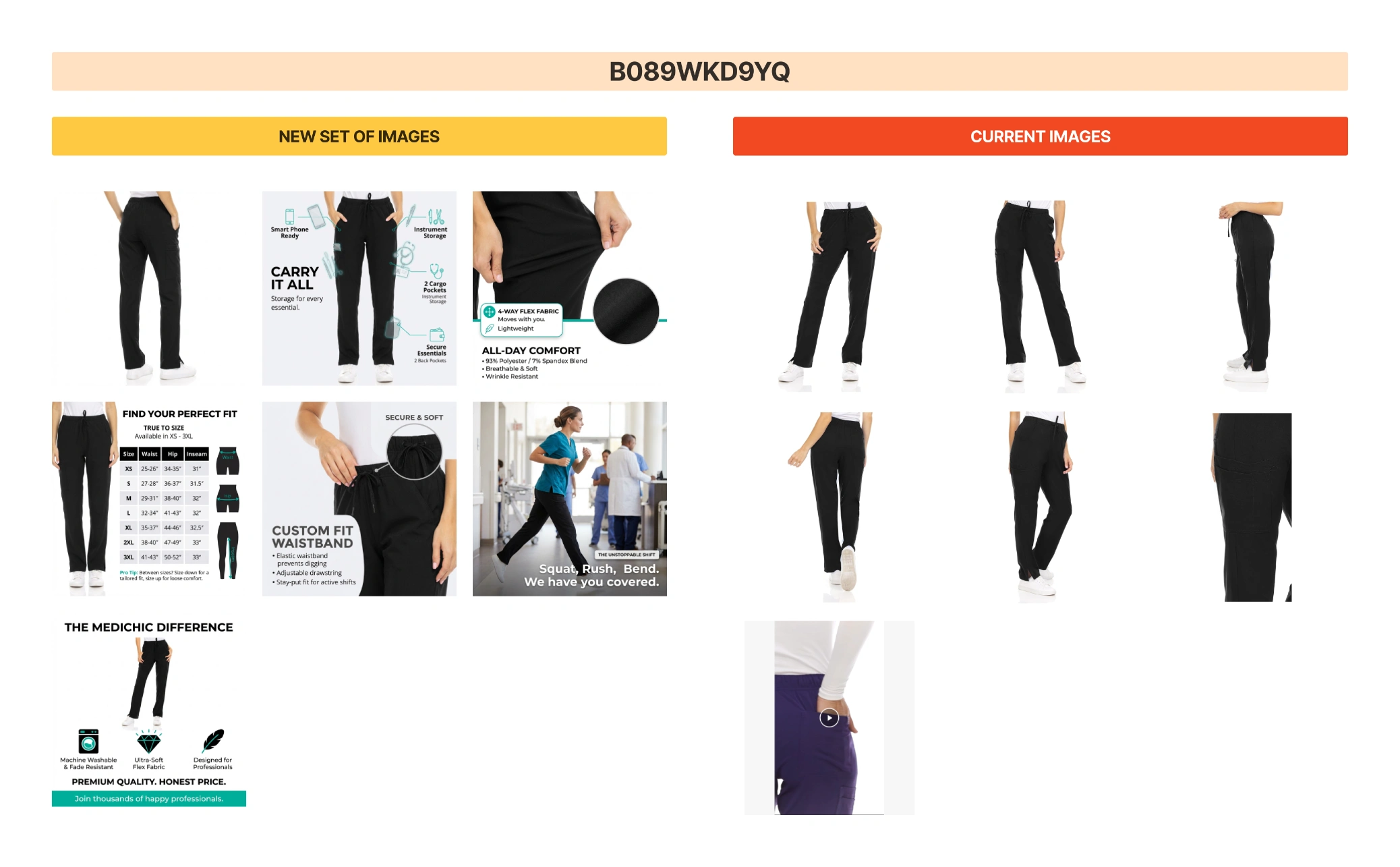
MediChic

Returns in workwear come from sizing and from pockets that turn out to be decorative. The set counts the pockets, shows the fabric moving, and puts a fit chart across body types in the gallery so the shopper sizes correctly the first time.

Hosiery

Shinesty

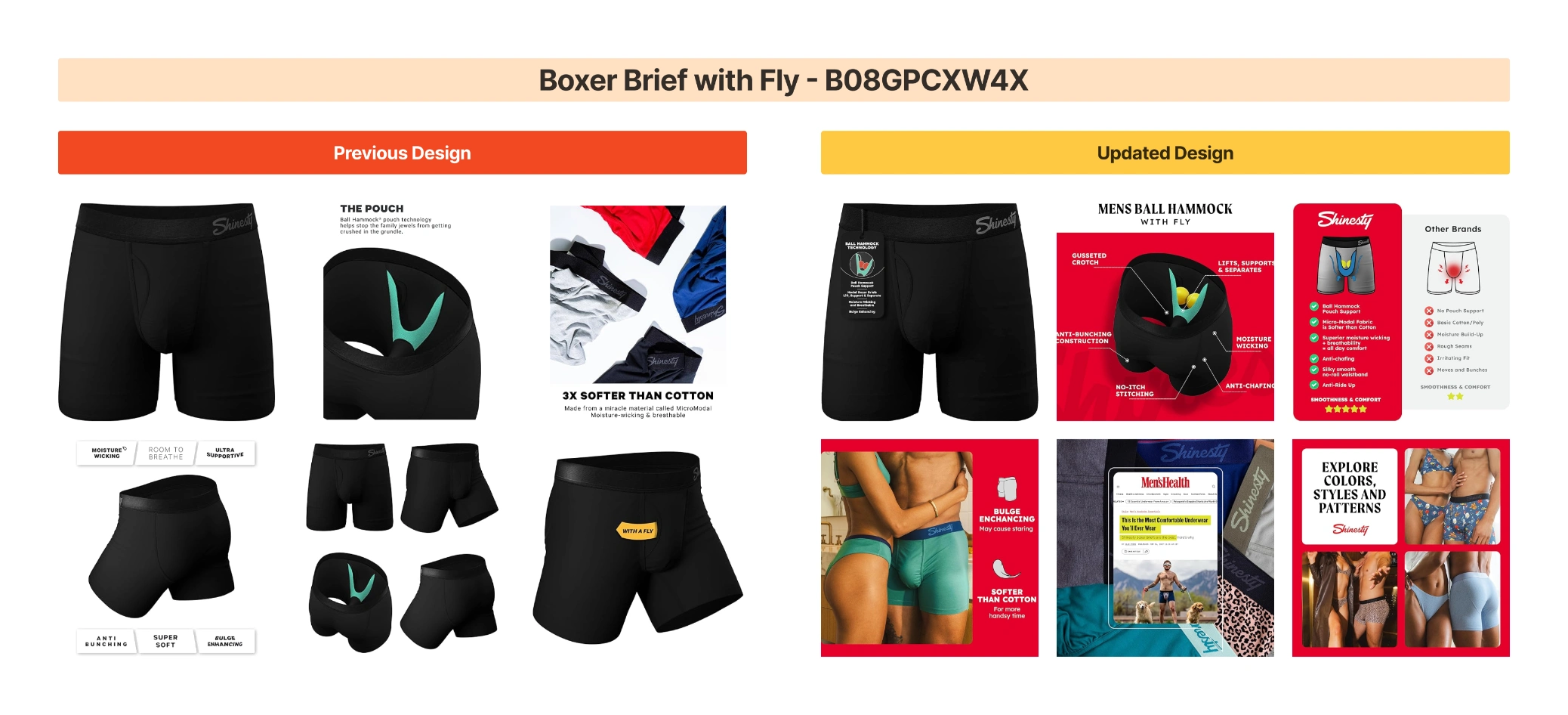
Softness is the entire pitch and it cannot be photographed. The set converts the claim into a fiber composition callout and a construction diagram, adds a shoe-size table to kill the sizing question, and shows what the cheap alternative does after a few washes.

Industrial supply

FyterTech

Industrial buyers spec before they shop, so the gallery is a datasheet. Fluid types, thickness, pack count and sheet dimensions are all on the image, and the last slot names the environments the mats are rated for rather than showing another studio shot.

Automotive parts

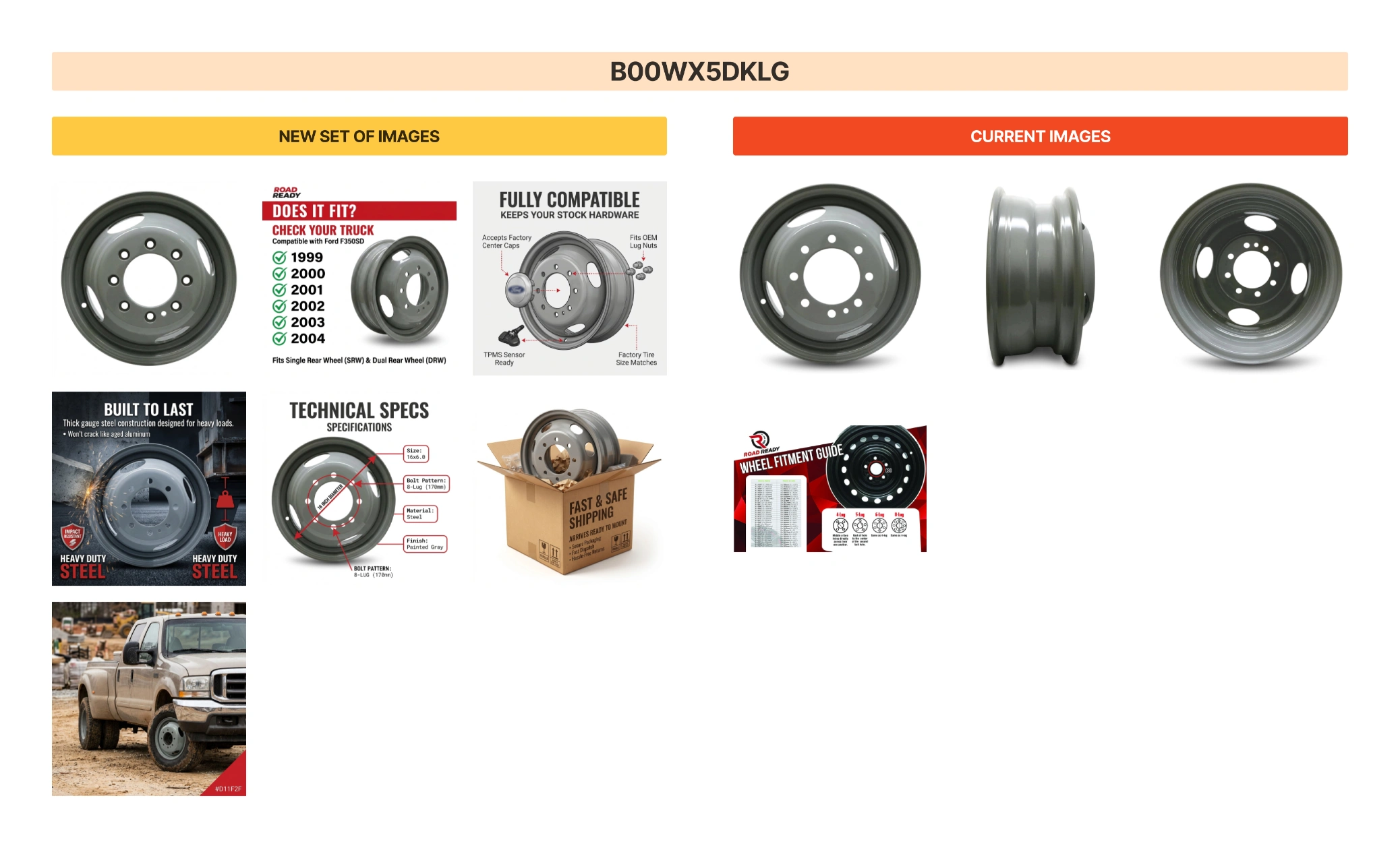
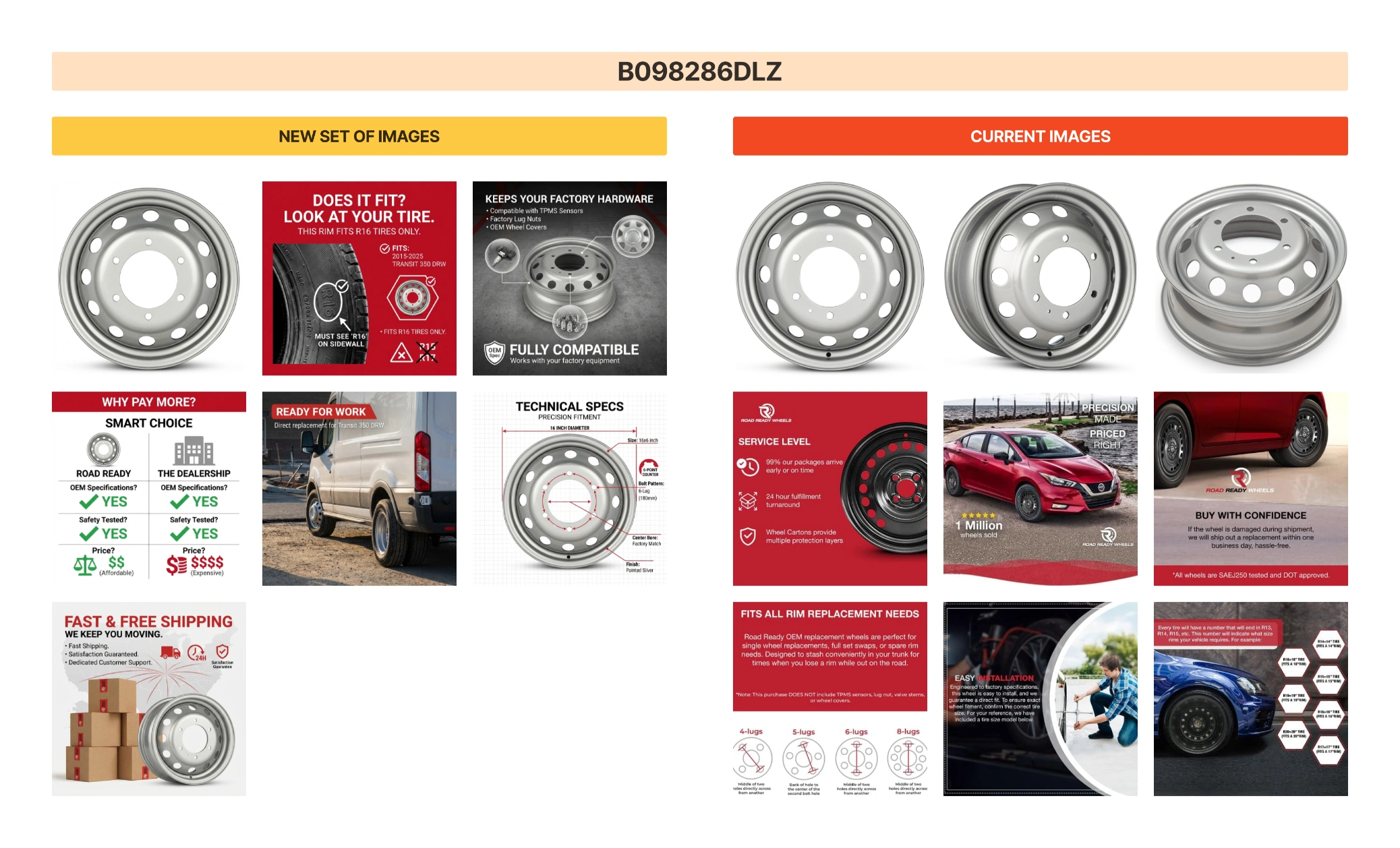
Road Ready Wheels

Fitment is the only question that matters, because the wrong rim is a return and a bad review. Vehicle, year range, bolt pattern and tire size are stated on the images before any lifestyle photography appears, which is the reverse of how the category usually orders a gallery.

Beverage

Mixology

Nobody buys a cocktail pouch for the pouch, they buy it for an occasion. The set leads on where it gets served, then handles the two questions that stall the order, which are how to mix it and whether it works without alcohol.

Your Adverio Team

Operators, not order-takers.

One operator owns the outcome, with the full bench reachable behind them.

Your point of contact Brand Strategist

One operator owns your P&L, the roadmap, and the number you are measured on. Before your first strategy call they pull two years of account history and 90 days of advertising detail, then build the plan from your raw data rather than from a sales deck.

The person who builds the strategy is the person who runs the account.

We match your strategist to your catalog, your category, and the shelves you run, then name them at signature. That is why this seat carries a role instead of a headshot.

Amazon Walmart Target Plus

Marketplace specialists inform the plan for every shelf you run. The strategy stays one strategy. What changes by shelf is which levers exist to deliver it.

What that seat carries
Customer experience and conversion

What happens after the click. Detail page, offer posture, and the path from shelf to cart.

Search visibility

Organic rank and the terms your catalog is actually indexed for, not the ones you hoped for.

AI and agentic shopping

Whether an AI assistant quotes your listing when it decides what to add to a cart.

Catalog operations

Variations, flat files, inventory health, and the cases that keep listings live and indexed.

Creative and video

Copy, imagery, A+ content, and video across the listing and the storefront.

Margin recovery

Reimbursements owed back on fulfilled orders, plus carrier and freight overcharges.

Adverio leadership at the San Francisco operations summit

Your leadership team at our San Francisco operations summit.

Mike DanfordCSO and Co-founder
Saket GoenkaDirector of Operations
Alden WonnellCEO and Co-founder

San Francisco Operations Summit

Behind that seat sits the execution bench you can reach directly, covering advertising, copy, design, video, catalog, brand protection, freight, and reimbursements. You deal with one operator. You are never waiting on a queue to reach a specialist.

Advertising Specialist
Campaigns built to margin and TACoS.
Copywriter
Search-led detail page, mobile, and storefront copy.
Graphic Designer
Storefronts, A+ content, and detail pages.
Video Production
Listing, A+, Sponsored Brands, and storefront video.
Catalog Manager
Variations, flat files, inventory, and cases.
Brand Protection
IP and MAP, unauthorized sellers, policy review removals.
Carrier & Freight Recovery
Reviews contracts and recovers overcharges.
Reimbursements Specialist
Recovers reimbursements owed on fulfilled orders.

One team. Every lever. Built around your P&L.

Governance-first growth in practice.

Built for Large Catalogs (Where Others Break)

Listing optimization providers are usually built for single products. When catalogs grow, costs explode, quality drops, and execution slows. Adverio is designed for scale, across conversion, eligibility, and agent visibility layers.

Quality holds as the catalog grows

  • One set of image rules and one copy structure per catalog cluster
  • Built for brands, aggregators and portfolio sellers

Batches, not one listing at a time

  • A keyword map built for one variation carries to every child under the parent
  • Speed and consistency without a manual bottleneck on every SKU

Cost does not track SKU count

  • We do not charge per title, per bullet or per image
  • You pay for the decision, not the hour it took to type it
  • Built for a catalog you keep, not a one-off project

Add a thousand SKUs to a per-listing vendor and you add a thousand invoices. Add them here and the system already knows what to do with them.

Typical setup vs Adverio

Anyone can rewrite a listing. Only one setup can show you what changed and when.

Most comparisons come down to a per-listing rate. The difference that shows up six months later is whether anyone can tell you what was edited, why, and what it did.

The typical setup

You buy listing edits. Nobody can reconstruct what changed.

Copy gets rewritten once at onboarding, backend search terms get set and forgotten, and refreshes happen when somebody remembers. When rank moves there is no record to work backwards from.

The structural risk

The cost is not the per-listing rate. It is losing the ability to tell whether the last change helped or hurt.

The Adverio model

You get catalog operations. Versioned, governed, and on a contracted cadence.

Every listing change is version controlled, backend search terms are governed rather than set once, and the refresh schedule is written into the engagement rather than left to memory.

The structural advantage

The partnership funds the record that lets you attribute a rank change to a decision.

Decision point The typical setup Adverio
Whether changes can be traced The typical setupEdits are made in place. Six months on, nobody can say what the listing said before or who changed it. AdverioChanges are version controlled, so we can show you exactly what changed and when it changed.
How backend search terms are handled The typical setupSet at onboarding, then left. They drift out of relevance as the category moves. AdverioGoverned on a schedule, reviewed against current search query data rather than the terms that were right at launch.
When content gets refreshed The typical setupWhen someone notices a problem, which is usually after rank has already moved. AdverioOn a cadence written into the engagement, so the refresh happens before the decay shows up in the numbers.

Either setup can rewrite a listing. Only one of them can tell you what that rewrite did, and when it did it.

That is the comparison that matters. Not just the per-listing rate. The record that lets you learn from every change.
Find My Margin Leaks

We either find leaks or confirm you are already optimized.

The specifics

Positioning is easy to write. Below is a slice of our operating commitments we defend in a room against anyone.


Where most of the work sits

Catalog work is versioned, governed, and on a contracted cadence.

Listing changes are version tracked, so we can show you what changed and when. Backend search terms are managed at the listing and variation level. Refresh is prioritized by our Revenue Impact Formula rather than a fixed calendar, because sometimes new content beats refreshing what is already there, and seasonality changes which one wins.

Detail page traffic and search traffic run as separate campaigns.

Blend them and a detail page that converts well quietly subsidizes a search term that doesn't, because the placement control inside one campaign moves every target at once. Run them apart and each placement gets its own bid, budget, and read. Amazon offers no true placement exclusion, so this is deliberate weighting, gated on click volume.

Your P&L gets read every week. Not just the ad report.

Contribution margin is reviewed weekly, not monthly, because weekly is where a margin leak gets caught while it's still small.

The forecast is built on your search query data, not on category averages.

Total category size tells you the ceiling. It doesn't tell you what you can reach this year. We build both from your own search query performance, then model the share you can realistically reach at 90 and 365 days and price what it costs to get there.

Our Optimization Loop (Fast, Measurable, Repeatable)

Every engagement follows a structured closed-loop system designed to diagnose, build, validate, and compound performance over time.

Diagnose

Establish baseline across LQS, CTR, CVR, indexation, eligibility, and buyer-intent mapping.

  • Visibility & suppression blockers
  • Extractability gaps
  • Conversion friction points

Build

Deploy structured conversion systems across copy, media, A+, offers, and storefronts.

  • Intent-aligned messaging
  • Visual frameworks
  • Scalable architecture

Validate

Assets are stress-tested before going live.

  • Internal scoring framework
  • Five-second clarity test
  • Variant comparison (V2/V3)
  • Compliance & extractability recheck
We don't upload and hope. Validation prevents costly CTR drops.

Launch

Controlled rollouts with compliance cleared and performance assumptions documented.

  • No fragile pushes
  • Staged variant testing
  • Eligibility confirmed

Iterate

Performance compounds through disciplined experimentation.

  • LQS, CTR, CVR tracking
  • Rank velocity analysis
  • Monthly experiment cadence
One structured experiment per month per asset class, validated variants ready to deploy.

The timeline

What You'll See in 30 / 60 / 90 Days

Phase 1

  • LQS 8.0+ out of 10 on priority SKUs following review, eligibility gating, and baseline fixes
  • Buyer-intent aligned titles, bullets, and primary media deployed
  • Visual system framework defined, image-type mapping and POE feature prioritization
  • A+ wireframes approved, early CTR and extractability signals emerging

Phase 2

  • Design-centric A+ and structured visual variants live
  • Query-to-SKU alignment tightened, and rank velocity improving
  • First validated creative experiments deployed, main image and gallery stack
  • Review cadence, Q and A coverage, and trust signals compounding

Phase 3

  • Storefront refresh live with multi-path navigation and tested video variants
  • Paid media scaled confidently behind validated PDPs, not assumption
  • Structured monthly experiment cadence in place, V2 and V3 creative iterations
  • Board-ready reporting tied to conversion lift, rank velocity, and revenue impact

Strong SEO fuels stronger ads. As listings rank higher and convert faster, every PPC and DSP dollar earns more.

Optimize My Brand

What You Get (Communication & Reporting)

One Team On Your Catalog

Brand Manager, Creative Lead and Conversion Systems Specialists working the same catalog, with the same weekly review.

Live Consults & Fast Responses

Live consults, Loom recaps, and rapid iteration syncs.

Validation reviews, experiment planning, and creative scoring happen collaboratively, not behind closed doors.

24/7 Live Dashboard

Live visibility into LQS, query-level rank movement, CTR and CVR deltas, experiment status, and profit impact.

Operators and finance teams see the same truth, conversion lift tied to revenue movement.

End-of-Month Digest

What changed, what validated, what failed, and what scales next.

Board-ready reporting tied to conversion, eligibility health, rank velocity, and revenue impact.

Frequently Asked Questions

Will this help ads?

Yes. Amazon listing optimization improves PDP conversion, which lifts organic rank and makes paid advertising more efficient. We don't scale spend until listings convert.

Is this just "pretty pictures"?

No. Amazon listing optimization services focus on conversion, not aesthetics. Every asset exists to remove a buying objection or prove value. If it won't move CVR, it won't make the plan.

How do you measure success?

We measure success by how well your Amazon listings convert and hold rank. We track CVR, add-to-cart rate, query-level rank movement and LQS delta as the primary set. Returns rate, review mix and velocity, and store dwell sit underneath them.

Do you need brand assets?

If you don't have them, we'll build a Brand Style Guide and create net-new assets end-to-end.

What if we're already good?

If your Amazon listings are already performing well, we provide a second-opinion review and a prioritized punch-list of incremental gains. Either way, you win.

How long does it take to see results from Amazon SEO?

Amazon SEO improvements can begin showing visibility gains within a few weeks, but results compound over time. The longer your listings stay optimized and convert well, the stronger and more stable your rankings become.

Do you provide backend keyword optimization for Amazon?

Absolutely. Backend optimization is one of the highest-return tasks in Amazon SEO. We manage backend search terms, metadata, long-tail keywords, and quarterly performance reviews and re-indexation checks against your own indexation data, to maximize discoverability while maintaining compliance.

What is the difference between Amazon SEO and Amazon PPC services?

Amazon SEO earns organic rank while PPC buys exposure. The two work together. PPC data improves SEO strategy, and stronger organic rankings make advertising more efficient.

How do Amazon SEO services handle multiple product catalogs?

Large catalogs are our specialty. For brands managing hundreds or thousands of SKUs, we segment by catalog role and run optimization in batches rather than one listing at a time, so we can prevent keyword cannibalization and scale changes efficiently across the catalog.

How much does Amazon search engine advertising cost?

Listing work is an investment in conversion rather than a fixed media cost. You see the projected profit math before committing, so every dollar is tied to a number you can check.

Verified Reviews

Testimonials

Named brands, named executives. Verified on Clutch, YouTube, and Upwork.

 Clutch reviews · 5.0 ★ 6 YouTube testimonials + Upwork reviews · 5.0 ★

Ready to stop sending great traffic to leaky PDPs?

We will show you where conversion is leaking and what to change first.

Show Me the Profit Math

15-minute call. No deck.

Score the listing before you change it. Adverio scores every SKU twice, once for whether a human converts and once for whether an AI shopping agent can add it to a cart, then sequences the fixes by revenue impact rather than by checklist. Listings are optimized in batches across catalogs of 10 to thousands of SKUs, so cost does not scale with SKU count. The order matters, because ads amplify what a listing already does. A page that does not convert turns every ad dollar behind it into a more expensive version of the same result.

References

  1. Amazon, 2024 SMB Impact Report. Third-party seller share of total sales and active seller count.
  2. Jungle Scout, 2024 FBA fee analysis. Average fee increase and fees as a share of selling price.
  3. Helium 10, 2025 State of the Seller Report. Net margin range after COGS, FBA fees, advertising and referral fees.
  4. Clutch, The New Rules of Brand Discovery. Buyer trust signals before purchase.